
3D Bioelectronic Interfaces for Multimodal Organ/Organoid on Chip Systems
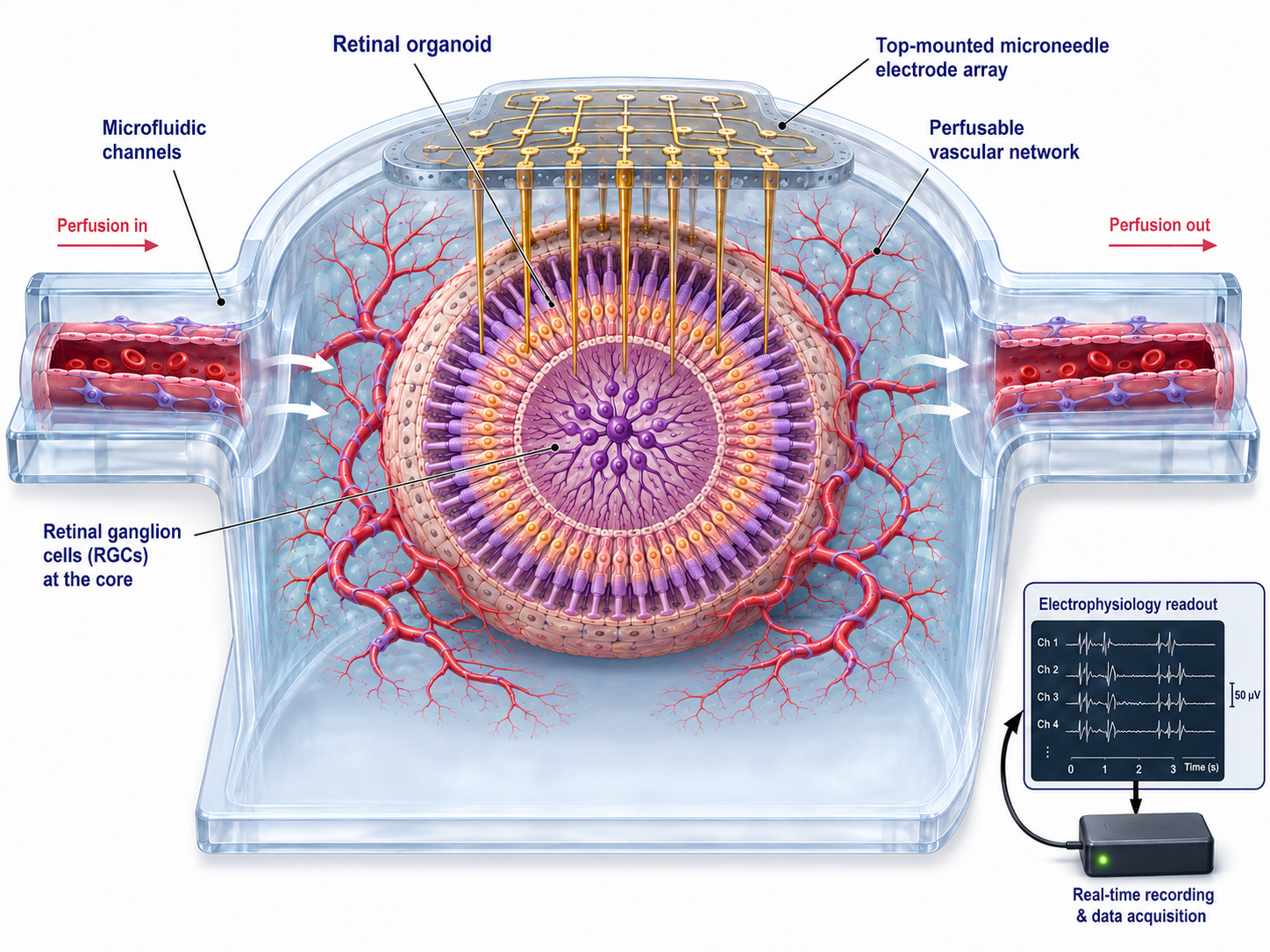
Progress in stem cell biology and tissue engineering has facilitated the engineering of submillimeter to centimeter scale spheroids, organoids, and tissues for studying human development and disease states. The emergence of these 3D multicellular biological systems calls for technologies that allow investigation of their behavior with modalities of interest ranging from electrophysiology and force measurements to thermal or chemical sensing and stimulation. Nonetheless, current technologies in neuroscience and mechanobiology have limitations in providing such modalities. For instance, existing microelectrode arrays have major setbacks due to their planar, rigid, and 2D geometries that limit their interaction with a 3D neural tissue to their basal contact regions with the arrays. Similarly, present approaches for characterizing contractility in engineered muscle tissues rely on optical measurement of their motion against a deformable structure, such as elastomeric pillars, which suffer from uncertainties in beam geometry, material constitutive properties, or imaging limitations.
We develop new classes of soft bioelectronic interfaces that integrate with biological tissues and provide continuous, objective readouts of tissue function. Our current work focuses on flexible 3D devices that measure electrophysiology in engineered, stem cell-derived neuromuscular and retinal systems, and quantify force and contractility in engineered skeletal, cardiac, and neuromuscular systems. These sensor-integrated biosystems support basic science studies of neural and muscular systems and drive efforts toward regenerative engineering and personalized medicine for ocular, neuromuscular, neurodegenerative, cardiac, and muscular dystrophy-related diseases.
Graduate students and RAs working on the project:
Neuromuscular and neurovascular systems - Fabiana Amato, David Berger, Samantha Mossuto, Jana Chan
Retinal systems - Fabiana Amato, Samantha Mossuto, Jana Chan, Isabella Nealy